Numbered Stitch Markers 0 to 9, Set of 10 Locking Enamel Charm Markers for Knitting and Crochet
Limited Availability!
Trusted by Crafters Worldwide ✔
No se pudo cargar la disponibilidad de recogida
Estimated delivery -
—
- Envío rápido
- 100% de garantía
- Pago seguro
GARANTIZAR
GARANTIZAR
Garantía de devolución de dinero de 45 días, 100 % libre de riesgos. Si hay algún problema con tu pedido, puedes comunicarte con nuestro útil equipo de atención al cliente para obtener un reembolso.
ENVÍO
ENVÍO
El plazo de entrega es de 5 a 12 días hábiles; sin embargo, podría recibir sus artículos mucho antes. Todos los pedidos se envían con número de seguimiento para que pueda seguirlos en todo momento. Recibirá un correo electrónico con el número de seguimiento una vez enviado el pedido.
Pago seguro
Pago seguro
Pagos seguros con Stripe® y PayPal. Utilizamos seguridad SSL cifrada para una protección total.
APOYO
APOYO
Contamos con un sistema de tickets disponible las 24 horas, los 7 días de la semana, los 365 días del año, con soporte telefónico y por correo electrónico. Contáctanos si necesitas ayuda.
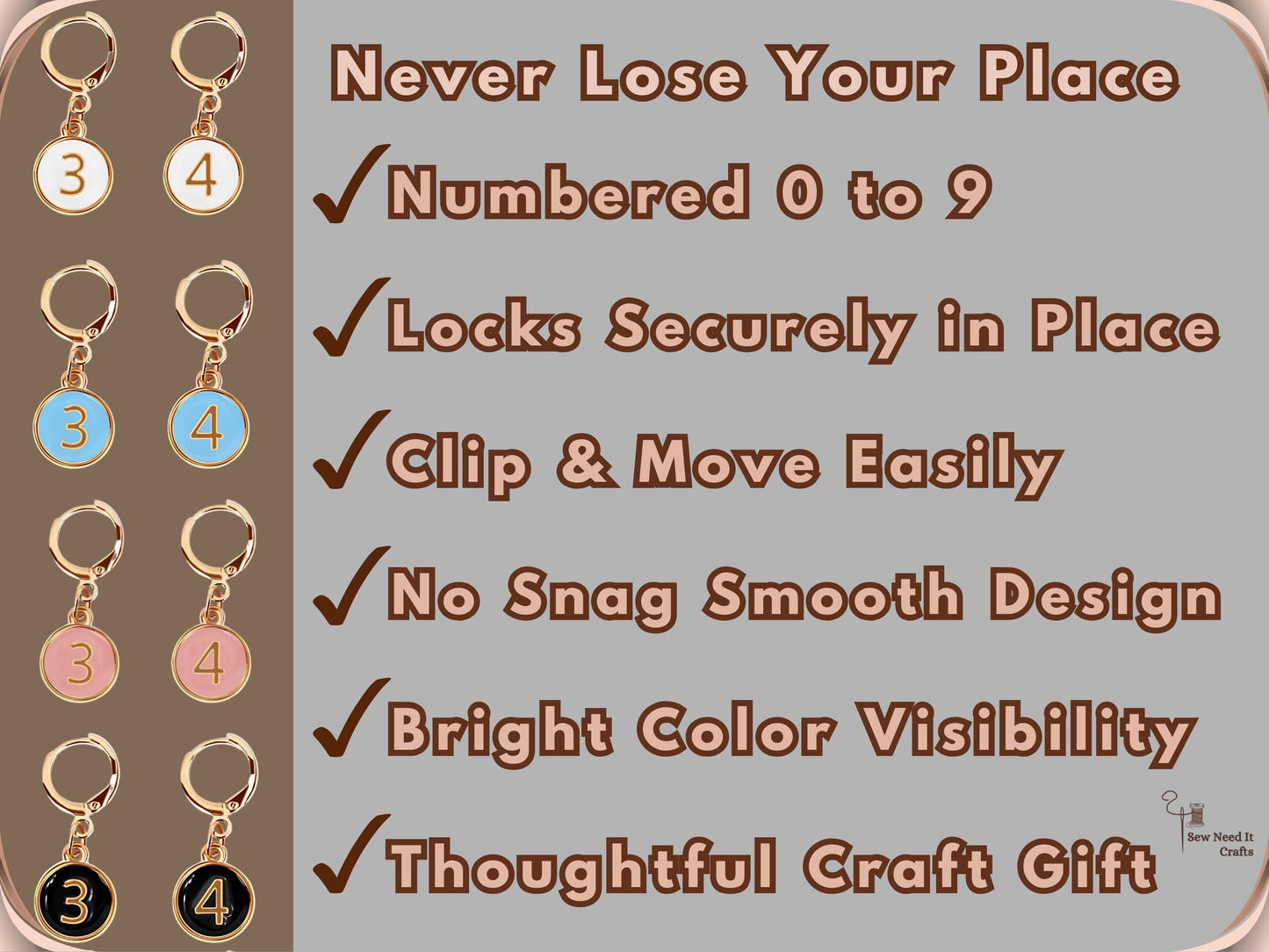
Ten numbered stitch markers, 0 through 9, each on a small gold-tone hoop that snaps open and shut. You clip one straight into a stitch, a chain space or the edge of a row, and the number tells you where you are — no separate notebook, no recounting from the cast-on edge when the phone rings.
Because the hoop opens, these work the same way in knitting and in crochet. A closed ring marker has to be threaded onto a needle before you start and can only ever sit there. These go on and come off wherever you like, mid-row, on the needle or in the fabric itself, and they come off again just as easily when the piece is finished.
How to Use Them
The quickest way to use a numbered set is as milestones rather than one marker per row. Decide what one marker is worth — 5 rows or 10 rows are the usual choices — then clip the next number into the edge each time you get there.
- Every 10 rows: marker 1 at row 10, marker 2 at row 20, and so on. Ten markers carry you to row 100.
- Every 5 rows: better for textured or dark fabric where rows are hard to read back. Ten markers carry you to row 50.
- Counting a long cast-on: clip a marker in every 20 stitches so you never recount the whole edge.
- Working in the round: keep 0 as your start-of-round marker and use the rest for round milestones.
The point of the system is that if you put the work down and lose your place, you only ever count back to the last marker.

Product Details
- Set of 10 markers, numbered 0 to 9 — one of each digit
- Flat round enamel charm, 1.2 cm / 0.47 in across, with the number in gold
- Overall length including the hoop: 3.1 cm / 1.22 in
- Gold-tone metal hoop with a hinged clasp that snaps closed
- Available in black, white, pink or blue — one colour per set
- Arrives on a printed card, so the set stays in order until you use it

Who They're For
Anyone who counts. Blanket and scarf makers working long stretches of the same stitch, sock and sleeve knitters who need both pieces to match, amigurumi makers tracking rounds, and beginners following a written pattern for the first time. They are equally at home on a knitting needle and clipped into a crochet stitch, which is why one set covers both crafts instead of two.

How This Compares
Against closed ring markers. A closed ring has to go onto the needle before you cast on and stays there until the piece comes off. These open, so you can add one at row 40 without unpicking anything, and you can clip into crochet fabric where a closed ring simply cannot go.
Against split rings. A split ring opens, but the gap that lets it open is also the gap that catches yarn and works its way loose. The clasp here closes into a complete circle with nothing sticking out, so the marker stays where you put it and comes away cleanly from mohair, chenille and loosely spun wool.
Against a mechanical or app row counter. A counter tells you a number; it does not tell you where that number is in the work. These leave the count physically in the fabric, which is what you actually want when you come back to a project after three weeks.
Against plain unmarked markers. Plain markers tell you that something happens here. Numbered ones tell you which something. That is the whole difference between marking a place and keeping a count.
Choosing a Colour
All four sets are identical apart from the enamel. Black gives the sharpest contrast and is easiest to read at a glance across light-coloured yarn. White, pink and blue read best against darker work. Plenty of makers buy two colours and use the difference as a second layer of information — pink on the left sleeve, blue on the right, so a glance tells you which piece you are holding.

Materials & Care
Metal charm with a smooth enamel face and a gold-tone plated hoop. The charm is flat and bezel-set rather than a dangling bead cluster, so there is no open jump ring to snag and nothing heavy pulling on fine yarn.
Wipe with a dry cloth. Take the markers off before washing or blocking a finished piece, and keep them on their card or in a small tin between projects so the enamel faces do not rub against each other.
Questions People Ask
How do stitch markers work? They sit in the work as a physical bookmark. You place one at a spot you need to find again — the start of a round, an increase point, every tenth row — and when you come back to it, the marker is still there. With a numbered set the marker also carries the count, so you know not just that this is a milestone but which one.
How many stitch markers do I need? Ten covers most single projects comfortably. At one marker per ten rows that is a hundred rows of tracking, which is more than enough for a sock, a sleeve, a hat or a scarf. Blanket makers and anyone working two matching pieces at once tend to keep a second set in a different colour.
Do you place a stitch marker before or after joining in the round? After. Join the round first, then place the marker on the needle or in the first stitch of the new round so it sits at the start of every round that follows. Keeping 0 as the round marker and the other nine for counting is a tidy way to do it.
Can you use a safety pin instead of a stitch marker? Yes, and that is exactly the principle these use — a closure you can open and shut anywhere in the work. The difference is the finish: a safety pin has an exposed point and a sharp coil that catch yarn, where the clasp here closes flush and the charm face is smooth.
What can I use instead of stitch markers? A loop of scrap yarn, a paperclip or a bobby pin will all get you through a row in an emergency. They are worth knowing about, and they are also why a proper set is a small upgrade rather than a luxury — scrap yarn has to be cut out, and none of the improvised options can tell you which row you are on.
Do these work for crochet as well as knitting? Yes — the opening hoop is exactly what crochet needs, because a crochet stitch has no needle to hold a closed ring. Clip it straight into the top of a stitch or a chain space and move it up as you go. (This question is not from Google's People Also Ask; it came up repeatedly in the AI shopping-assistant research for this category.)
Ten numbers, one clasp that actually closes, and no more counting back to the cast-on edge.
Compartir