


Cross Stitch Lap Stand - Sit-On Beechwood Embroidery Hoop Holder with Adjustable Height
Cross Stitch Lap Stand - Sit-On Beechwood Embroidery Hoop Holder with Adjustable Height
Limited Availability!
Trusted by Crafters Worldwide ✔
Couldn't load pickup availability
Estimated delivery -
—
- Fast Shipping
- 100% Guarantee
- Secure Checkout
GUARANTEE - 45-Day Money Back Guarantee
GUARANTEE - 45-Day Money Back Guarantee
100% Risk Free 45 Day Money Back Guarantee. If something is wrong with your order, you can contact our helpful customer support team to get a refund.
SHIPPING - 5–12 Business Days (Tracked)
SHIPPING - 5–12 Business Days (Tracked)
Please allow 5 to 12 business days for delivery, however, you may receive your items much earlier. All orders are shipped with tracking numbers so you can track them every step of the way! You will receive an email with tracking number once the order is shipped.
SECURE CHECKOUT - 100% Encrypted
SECURE CHECKOUT - 100% Encrypted
Safe payments via Stripe® and PayPal. We use encrypted SSL security for 100% protection.
SUPPORT - Fast & Friendly
SUPPORT - Fast & Friendly
We have 24/7/365 Ticket system with Phone and Email Support. Please contact us if you need assistance.
An hour into a piece of cross stitch it is usually your shoulders that give out first — not your eyes, not your fingers. Holding a hoop up in front of you with one hand while the other stitches is quietly hard work, and it is why so many good evenings end earlier than you wanted them to.
Sit on the base of this stand and that stops being a problem. The board slides under your thigh, your own weight holds it steady, and the hoop sits up in front of you at whatever height you set. Both hands come free — one above the fabric, one below — and you can stitch the way the technique is actually meant to be worked, for as long as you like.
It moves with you, too. The upright telescopes from 31 cm to 42 cm, so you can bring the work up to your eyeline in a low armchair or drop it down when you are sitting at a table, and the clip head tilts to whatever angle keeps your neck straight. Two wooden knobs do all of it. No tools, no allen key, nothing to lose down the side of the sofa.
And when you are finished it comes apart into four beech pieces weighing 600 g altogether — light enough to go in a tote bag to a stitching group, small enough that it does not need a corner of the room the way a floor stand does.

Why You'll Love It
- Both hands free. One hand above the fabric, one below — the stab-stitch method that gives you even, tidy stitches and stops you gripping the hoop all evening.
- You sit on it, so it cannot wander. No clamp to fit to a table, no floor space to find. Your own weight is what anchors it.
- Sit-on or tabletop, same stand. Slide the base under your thigh in an armchair, or stand it on a desk or side table. It works either way with nothing to change.
- Height that actually adjusts. 31 cm to 42 cm of travel, so the work comes up to you rather than you leaning down to it.
- The head tilts and turns. Angle the hoop to suit how you are sitting, swing it aside to reach for thread, or turn it over to check the back of the work.
- 600 g and four pieces. It breaks down by hand in seconds and travels in a bag. That is roughly the weight of a paperback.
- Beech, not softwood. A close, hard-grained timber that takes a screw thread and keeps it. The clamp knob threads into a metal insert, not straight into the wood.
How It Works
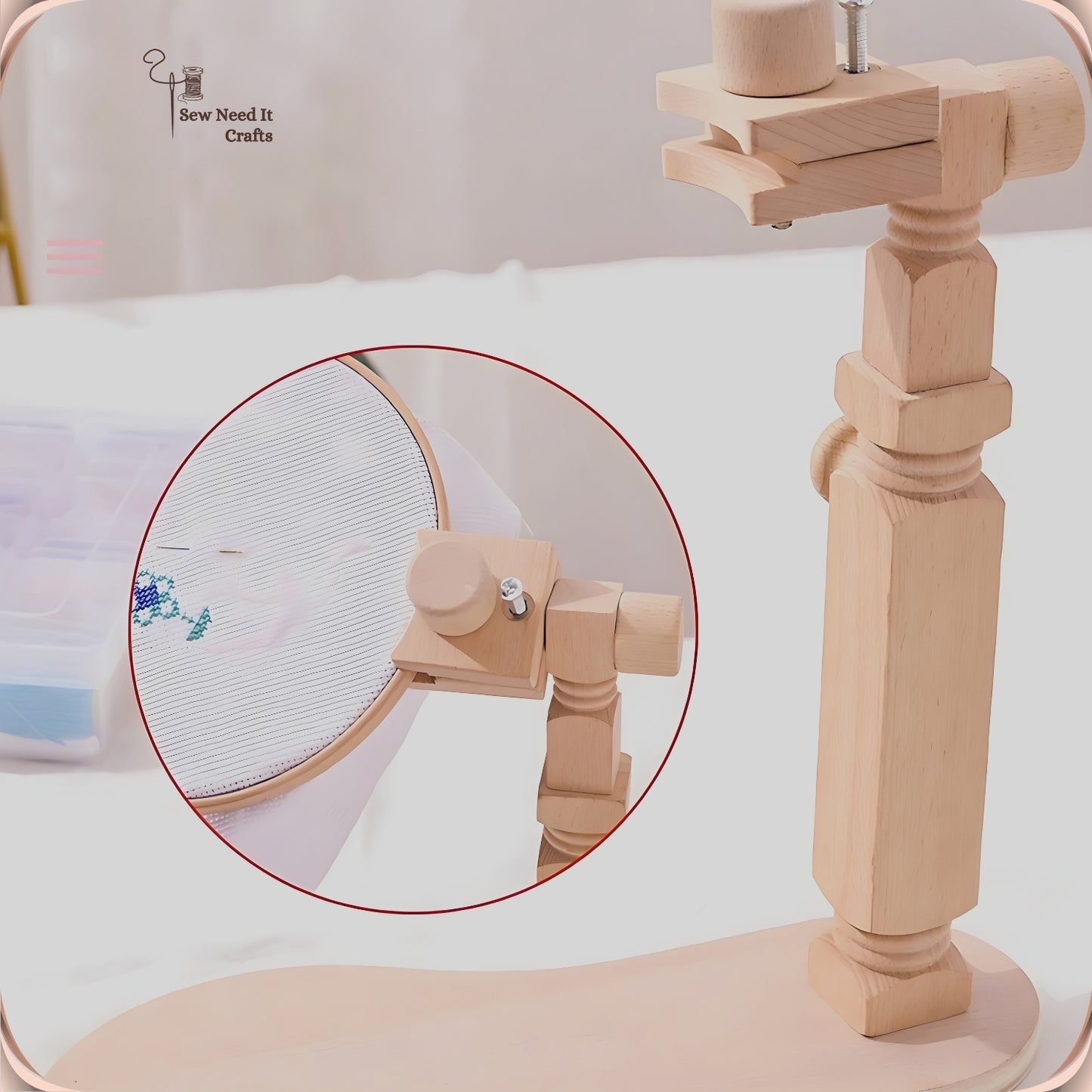
The clip head at the top is a pair of flat beech plates with a steel screw running down through them into the block below, topped with a wooden knob. Back the knob off, slide your hoop's rim in between the plates, and tighten. The jaw opens to 2.5 cm (1 inch), so it grips a hoop by the edge rather than needing a fitting of its own — and it holds a rim that thick without slipping, because the pressure comes from a metal thread rather than friction on bare wood.
Underneath that, the upright is two pieces: an inner pole that slides up out of an outer post, locked wherever you want it by the second knob. That is the height adjustment, and it is also what lets the whole head turn — loosen it a little and the top swings round, so you can move the work out of your way without unclamping anything.

Setting It Up
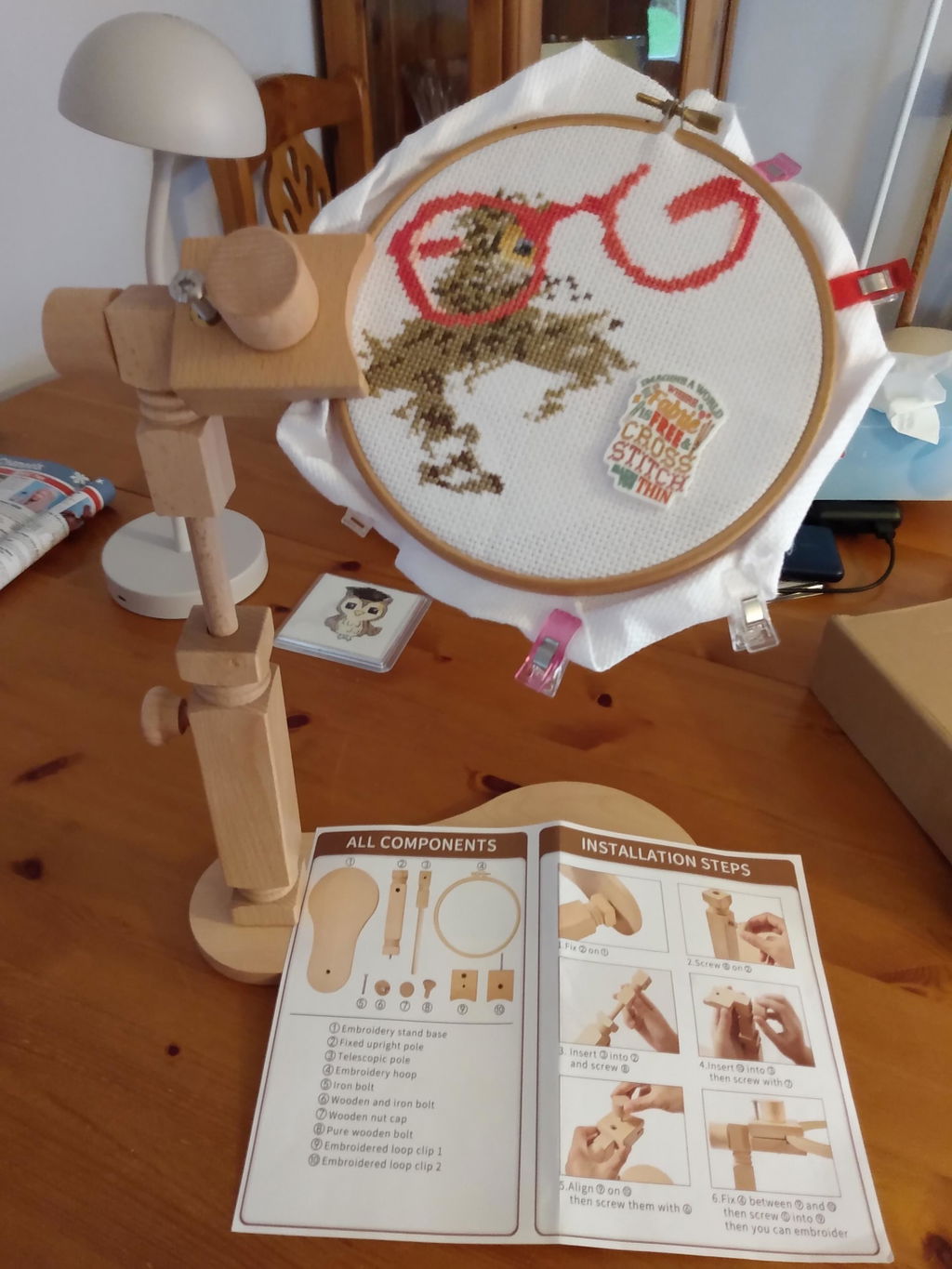
Four parts, no tools, about a minute the first time:
- Screw the outer post down into the base board.
- Drop the inner lifting pole into the post and fit the knob that locks it.
- Fit the clip head onto the top of the pole.
- Thread the knob down through the clip plates.
After that it stays assembled if you want it to, or comes apart just as quickly when you are packing it away.

Product Details
- Adjustable height: 31 cm to 42 cm (12.2 in to 16.5 in) — 11 cm / 4.4 in of travel
- Base board: 28.8 cm long (11.4 in), 1.2 cm thick
- Clip head: 10 cm across
- Jaw opening: holds a rim up to 2.5 cm (1 in) thick
- Weight: 600 g (about 1 lb 5 oz)
- Material: beech wood, with a steel tightening screw running into a metal insert
- Assembly: four parts, hand-tightened, no tools
- In the box: one stand. Hoop not included — it is built to hold the hoops you already own
Who It's For
Anyone who stitches sitting down and has started to notice it afterwards. Cross stitchers working a long piece over weeks, hand embroiderers doing surface work or ribbon work, needlepointers, punch needle and rug hooking — anything held in a hoop while you work it.
It suits armchair and sofa stitching particularly well, because sitting on the base is what makes it stable; you do not need a table edge to clamp to or floor space to stand it in. It is also the one to take out of the house. If you go to a stitching group, a class, or a retreat, four light pieces in a tote is a different proposition from carrying a floor stand.

How This Compares
Against a floor stand. A floor stand is excellent if you have a permanent stitching corner and never move. This one goes where you sit, folds down to four pieces, and does not stay in the middle of the room when you are not using it.
Against a clamp-on table stand. A table clamp needs a table with the right kind of edge, which rules out most armchairs and a good many side tables. Sitting on the base works in any chair you can sit in.
Against a lap stand with legs that rest on your thighs. Those move when you move. This one is pinned by your own weight on a 28.8 cm board, so the work stays where you put it.
Against holding the hoop. The obvious one, and the reason most people buy a stand. Two free hands is faster and more even than one, and your shoulders stay out of it.
Against a stand that comes with its own hoop. Those tie you to one size. This clamps by the rim, so it takes whatever hoops you have already collected — wood or plastic, round or oval — up to 2.5 cm thick.
Sizing, Materials & Care
Beech is the traditional choice for needlework tools for good reason: it is dense and close-grained, so turned parts stay round, threads stay crisp, and there is no resin to mark your fabric. The surface is sanded and polished bare — no lacquer, no stain — so it stays warm in the hand and picks up a slight sheen with use.
Keep it dry and wipe it with a cloth. If a knob ever feels loose, it is the thread wanting a quarter turn, not a fault. Like anything with wooden threads it will feel slightly stiff for the first few uses and then loosen into its proper action.

Questions Stitchers Ask
Are cross stitch stands worth it?
For anyone stitching more than an hour at a time, yes — and the reason is less about comfort than about technique. With the hoop held for you, you can work two-handed: needle down through the fabric with the hand on top, catch it and push back up with the hand underneath. Stitches come out more even, you work faster, and your shoulders and wrists are not doing a job they were never meant to do.
What type of embroidery stand should I use?
It depends mostly on where you stitch. If you always work at the same desk, a clamp-on table stand is tidy. If you have a dedicated corner, a floor stand is the most adjustable. If you stitch in an armchair or on the sofa, move between rooms, or take your work out of the house, a sit-on lap stand like this one is the type that fits — it needs nothing but a chair, and it packs down.
What is the best lap stand for cross stitch?
Judge them on four things: how far the height adjusts, whether the head tilts and turns so you can reach the back of the work, whether the clamp takes the frames you already own, and how easily it packs away. This one adjusts through 11 cm, tilts and swings at the head, grips any rim up to 2.5 cm, and breaks into four pieces weighing 600 g together.
Which hoops fit it?
Any hoop whose rim is 2.5 cm (1 inch) thick or less — which covers ordinary wooden and plastic embroidery hoops in every common size, round or oval. The clip grips a flat edge rather than a specific fitting, so any flat-edged frame within that opening will hold: measure the edge you intend to clamp and you will know straight away.
Can I get at the back of my work?
Yes. Loosen the height knob a little and the head turns, so you can swing the hoop round or tip it over to check tension, bury an end, or fix a stitch, then bring it back without unclamping and re-tensioning the fabric.
Can you use a scroll frame without a stand?
You can — plenty of people rest one on the arms of a chair or against a table edge. A stand is what makes it hands-free rather than balanced. This stand is designed around hoops and flat-edged frames up to 2.5 cm thick, which is where it does its best work.
One Last Thing
Set it up once, sit down with it, and you will notice the difference within about ten minutes — usually the moment you realise you have not put the hoop down or shaken your hand out. Hoop not included, because you almost certainly have the one you want already.


Very easy to put together even with my shaky hands. Hoop very secure. I put the base under my thigh and it took the pressure off my hand having to hold the hoop.
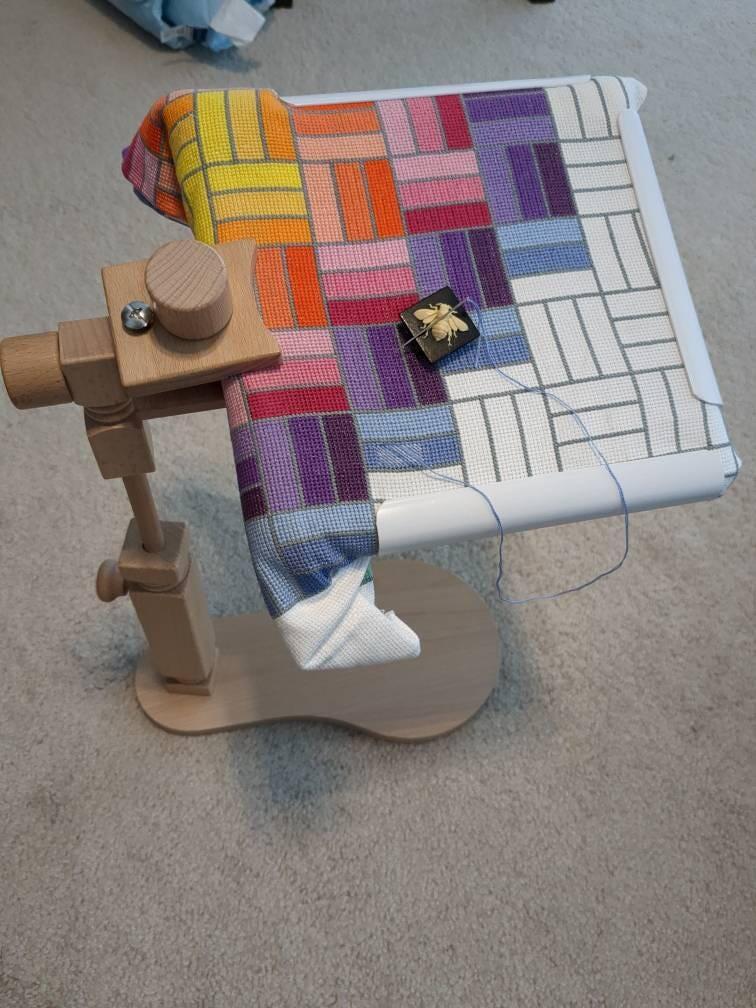
Item is as expected, works great to hold my cross stitch up. I use a q-snap frame for my projects and I have to take one of the sides off to fit in the stand, but the stand basically fills in the role anyway. If you use a thinner hoop I don't think you'll have the same issue.
Was on time good quality
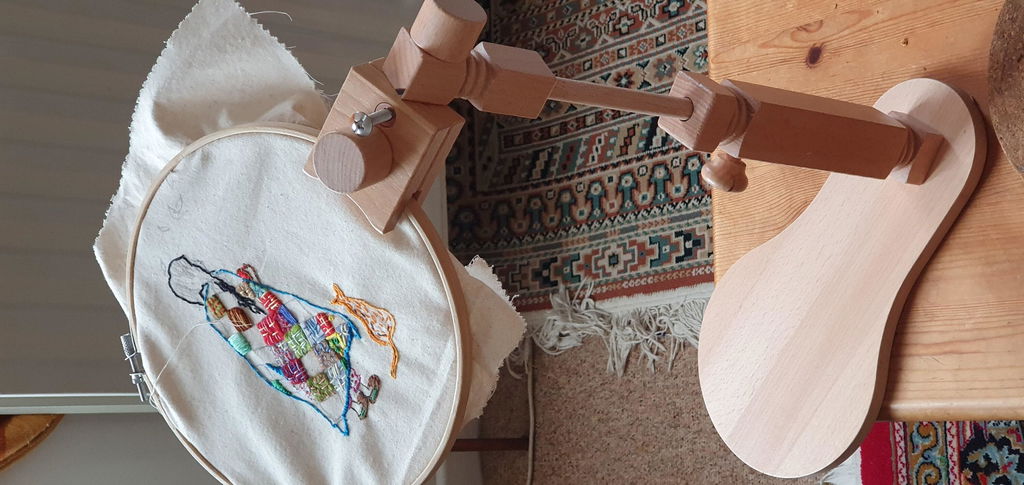
It is wonderful to stitch with 2 hands free. This embroidery stand was easy to assemble and is easy to use. I love it!
Excellent product and fast delivery
Great embroidery hoop holder.
Just what I was looking for. Perfect as I can swap out different sized hoops and am not restricted to having only one size hoop attached to the stand. Many thanks
I love this! It makes my handwork so much easier.
Hello, I ordered the product and noting happened. I got no notification that it was sent. After a week I PM her asking what was going on. I was told it was delivered in the mailbox. I received no tracking, no notification until I questioned her. When I was told it was in the mailbox, I received tracking the same day it was delivered. I was waiting for the product and was disappointed in the communication.
Looks sturdy and nicely put together once I assembled it. Hope it will work for me.
I bought this as a gift
I am very happy with this stand. It was easy to put together. The wood has a nice sealed finish. I was using it without any problems. I would recommend this stand.
It’s great thanks very
Good product the packaging was simple but secure
It gets the job done. Although I wish it could go up a little higher
Just the right size to sit with me in my rocking chair while I stitch and watch it snow! It's very nice, lots of adjustments.
To date, I have not received the item. This is not acceptable.
My friend loves this gift! She says her hands are way less crampy
Nice, well made, easy to follow
This is a well made hoop holder - would definitely recommend to everyone.
Ten out of ten, perfect gift
Very good item. Would recommend it
Impossible de faire tenir le cerceau correctement.
It's put together and I love how it looks. I haven't tried using it yet. I will doon.
Great piece of kit for embroidery, love it.
Great although waited well over a week for the delivery, which is why I only scored four for delivery
Article conforme à mes attentes
L ‘ articolo corrisponde esattamente a quello che volevo , é di ottima fattura ed arrivato in tempo record . Grazie sono pienamente soddisfatta !
Great quality, great service, just what I needed!
Very good quality. Wish it also came with a hoop.
I love it! Thank you!