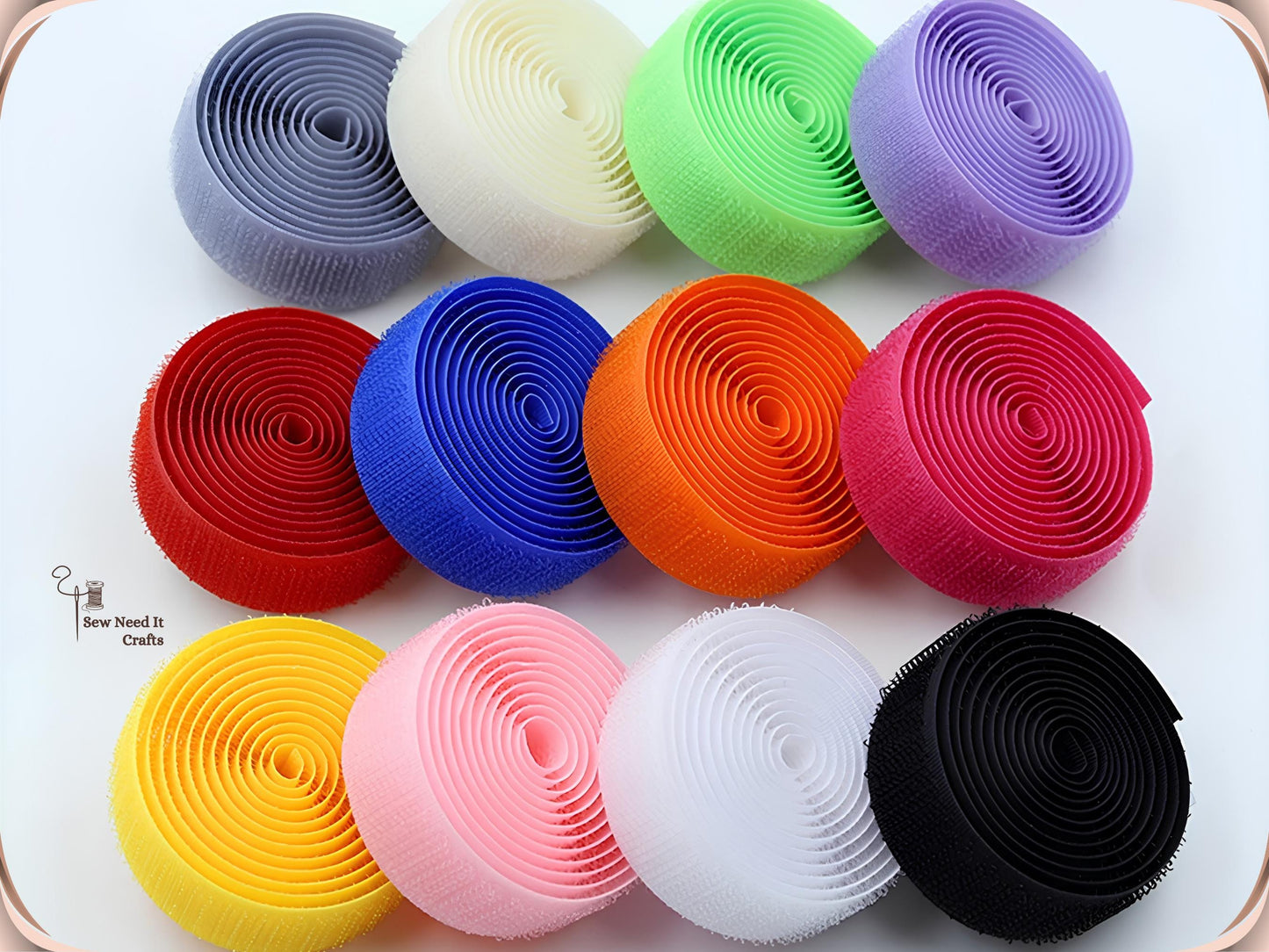
Sew On Hook and Loop Tape in 23 Colors — 2 m of Hook and 2 m of Loop, 20 mm Wide
Sew On Hook and Loop Tape in 23 Colors — 2 m of Hook and 2 m of Loop, 20 mm Wide
Limited Availability!
Trusted by Crafters Worldwide ✔
Couldn't load pickup availability
Estimated delivery -
—
- Fast Shipping
- 100% Guarantee
- Secure Checkout
GUARANTEE - 45-Day Money Back Guarantee
GUARANTEE - 45-Day Money Back Guarantee
100% Risk Free 45 Day Money Back Guarantee. If something is wrong with your order, you can contact our helpful customer support team to get a refund.
SHIPPING - 5–12 Business Days (Tracked)
SHIPPING - 5–12 Business Days (Tracked)
Please allow 5 to 12 business days for delivery, however, you may receive your items much earlier. All orders are shipped with tracking numbers so you can track them every step of the way! You will receive an email with tracking number once the order is shipped.
SECURE CHECKOUT - 100% Encrypted
SECURE CHECKOUT - 100% Encrypted
Safe payments via Stripe® and PayPal. We use encrypted SSL security for 100% protection.
SUPPORT - Fast & Friendly
SUPPORT - Fast & Friendly
We have 24/7/365 Ticket system with Phone and Email Support. Please contact us if you need assistance.
There is a moment in every sewing project where you have to decide how the thing closes. Buttons take time, zippers take nerve, and a strip of stark white hook and loop tape across a navy jacket announces itself from the other side of the room. This one comes in twenty-three colors, so you can pick a strip that sinks quietly into the fabric — or one that deliberately does not, if you are sewing for a child who needs to find the closure fast.
And because it is stitched in rather than stuck on, it stays put. There is no adhesive on the back to peel away at the corners, gum up your needle, or leave a grey sticky shadow on the fabric a year from now. You sew it once and it becomes part of the garment.
Every pack is a full pair: two metres of the hook side and two metres of the soft loop side, both 20 mm wide — just over three quarters of an inch, the everyday garment width. Cut what the project needs and the rest goes in the drawer for the next one.
What Comes in the Pack

- One 2 m strip of hook — the firmer, gripping side
- One 2 m strip of loop — the soft, napped side
- Both strips 20 mm (2 cm) wide, just over 3/4 inch
- Nylon and polyester blend, woven
- One color per pack, chosen from 23
- No adhesive backing and no peel-off liner — this is sew-on tape
How It Works

The hook side is covered in thousands of tiny stiff hooks. The loop side is a dense soft nap. Press the two together and the hooks catch in the nap; peel them apart and they let go with that familiar rasp, ready to do it again. Nothing wears out in normal use because nothing is being glued or bent permanently.
Both faces of this tape are plain woven fabric on the reverse, which is what makes it sewable. You stitch one strip to one side of the opening and the matching strip to the other, so they meet when the garment is closed.
How to Sew It In
- Cut both strips to the length you need, and round the corners slightly with your scissors so they cannot dig in or lift.
- Pin or clip the loop strip to the side that will face the body, and the hook strip to the side that faces away. The soft half against skin is the difference between a closure someone wears happily and one they take off.
- Stitch all the way round each strip, close to the edge. A slightly longer stitch length and a fresh universal needle make this much easier.
- For bag flaps, straps and anything under load, add a cross-box of stitching through the middle.
- Press the halves together to check the alignment before you trim your threads.
Choosing a Color

Twenty-three to choose from, in five useful families:
- Neutrals — White, Black, Beige, Camel, Gray
- Reds and pinks — Red, Dark Red, Rose Red, Orange Red, Light Pink
- Warm brights — Orange, Yellow, Fluorescent Yellow
- Blues and purples — Blue, Light Blue, Royal Blue, Purple, Light Purple
- Greens and browns — Green, Light Green, Dark Green, Brown, Coffee
If none of them is an exact match for your fabric, take the one a shade darker. A slightly dark strip reads as a shadow in a seam; a slightly light one reads as a mistake.
What to Use It On

This is a general-purpose garment and bag fastener, and 20 mm is wide enough to be easy to line up without being bulky:
- Adaptive clothing — replacing buttons and zips on shirts, cuffs and plackets for anyone whose hands no longer manage small fastenings
- Children's clothes — dressing-up costumes, coats, pockets, and anything a small person has to work themselves
- Bibs, nappies and baby gear — where a quick-release closure gets opened several times a day
- Bags and accessories — flaps, pockets, straps, pouches, lunch bags
- Cosplay and costume — hidden closures on pieces that have to come on and off quickly
- Repairs and alterations — shoe straps, cushion covers, curtain tie-backs, gaping waistbands
Sizing and Materials

- Width: 20 mm / 2 cm, measured on a digital caliper at 20.00 mm. That is 0.79 inch — a fraction over the 3/4 inch that most garment sewing calls for.
- Length: 2 metres (about 2 1/4 yards) of hook and 2 metres of loop. Not 2 metres shared between them.
- Material: nylon and polyester blend, woven, matte finish.
- Backing: none. No adhesive, no iron-on film, no release paper.
- Cutting: ordinary fabric scissors. Cut across the width to any length you like.
How This Compares
Against self-adhesive and stick-on hook and loop. Sticky-back tape is quicker on day one and worse on day two hundred. The adhesive fouls a sewing machine needle if you try to reinforce it, and on fabric it works loose at the corners first. Sewn-in tape has nothing to come unstuck.
Against the usual three-color ranges. Most sew-on hook and loop is sold in black, white and beige, and colored tape is often a separate premium line or a special order. Twenty-three colors here, all the same price.
Against sellers who split the two halves. A good deal of hook and loop is sold as hook rolls and loop rolls priced separately, which means two purchases before you can close anything. Both halves are in this pack.
Against buying by the yard. Trimmings suppliers sell colored sew-on tape cut to order, with minimums and sometimes a wait on the shade you want. This is a fixed pack that ships as stocked.
Questions People Ask
How do you sew on hook and loop tape? Cut both strips, round the corners, then stitch right round the outside edge of each one close to the border. Hand sewing works — a backstitch round the edge is plenty for clothing — and a machine is faster. Use a longer stitch than usual and go slowly over the hook side, which is the firmer of the two.
Is there a trick to sewing hook and loop tape? Three that make a real difference. Round the corners so nothing lifts. Sew the two halves separately and only join them at the end, because stitching through both at once is what tangles thread in the hooks. And close the fastener before you fold the finished piece away, so the hook side is not free to grab everything near it.
Can you sew a hook and loop patch? Yes — and that is the usual way to make one. Cut a square or a circle from each strip, round the edges, and stitch them where you want them. Because this comes as tape on a roll rather than pre-cut shapes, you decide the size, which is generally what you want for a bag flap or a cuff.
Why sew it on instead of sticking it on? Because the closure is going to be opened and shut hundreds of times, and stitches take that better than glue does. Adhesive tape is designed for smooth hard surfaces; on woven fabric it peels at the edges, and the residue it leaves is hard to get out. If a fastening has to survive being pulled, sewing is the answer.
Is hook and loop tape the same thing as Velcro? Velcro® is a registered trademark of Velcro IP Holdings LLC, and it names that company’s own branded fasteners. The fastening system itself — a hooked face that grips a napped face — is generically called hook and loop, and that is the correct name for what this is. This tape is not a Velcro® Brand product and is not affiliated with that company. If the brand name is simply the word you grew up with, “hook and loop” is the term to search for when you want the same kind of fastener.
Which side goes where? (Not a Google question — this one comes from the AI shopping research, where it was named as one of the things that separates a good result from a bad one.) Put the soft loop side on whichever face is more likely to touch skin, and the hook side on the face that points away. On a shirt placket that means loop on the underlap; on a cuff, loop on the inside.
Is 2 metres enough? For most projects, comfortably. As a rough guide before you measure your own pattern, a shirt placket tends to want somewhere around 20—30 cm, a bib tab only a few centimetres, a bag flap 15—20 cm, and a pair of adaptive trouser closures about 30 cm. On numbers like those, two metres of each half covers a run of several garments with some left in the drawer.
Pick your color, cut it to length, and stitch it in once.