Wooden Embroidery Hoops, Beech Hardwood — 3 to 12 Inch, Singles & Sets
Wooden Embroidery Hoops, Beech Hardwood — 3 to 12 Inch, Singles & Sets
Limited Availability!
Trusted by Crafters Worldwide ✔
Ne peut pas charger la disponibilité du ramassage
Estimated delivery -
—
- Expédition rapide
- Garantie à 100%
- Paiement sécurisé
GARANTIE
GARANTIE
Garantie de remboursement de 45 jours 100 % sans risque. Si quelque chose ne va pas avec votre commande, vous pouvez contacter notre équipe de support client pour obtenir un remboursement.
EXPÉDITION
EXPÉDITION
Veuillez prévoir un délai de livraison de 5 à 12 jours ouvrés. Cependant, vous pourriez recevoir vos articles bien plus tôt. Toutes les commandes sont expédiées avec un numéro de suivi pour un suivi optimal ! Vous recevrez un e-mail avec le numéro de suivi une fois votre commande expédiée.
Accueil sécurisé
Accueil sécurisé
Paiements sécurisés via Stripe® et PayPal. Nous utilisons le protocole SSL crypté pour une protection à 100 %.
SOUTIEN
SOUTIEN
Notre système de tickets est disponible 24h/24, 7j/7 et 365j/an, avec assistance par téléphone et par e-mail. N'hésitez pas à nous contacter si vous avez besoin d'aide.
Most hoops sold as “wooden” are bamboo — light, laminated, and prone to splintering along the inner edge once you have tightened them a few dozen times. These are solid beech, the hardwood that better-quality embroidery hoops have always been made from. The grain is dense and closes smooth when it is polished, so the inner ring stays kind to your thread instead of catching it — and the ring itself is joined and ground in a way that keeps fabric where you put it.
They come in nine sizes, from a 3 inch hoop for a brooch-sized motif up to a 12 inch for a full sampler, and you can buy any size on its own or take the whole range as a set. That is unusual. Most sellers offer one or two sizes in hardwood and leave you to piece a working collection together from three different shops.

Product Details
- Material: solid beech hardwood, sanded smooth, natural unstained finish
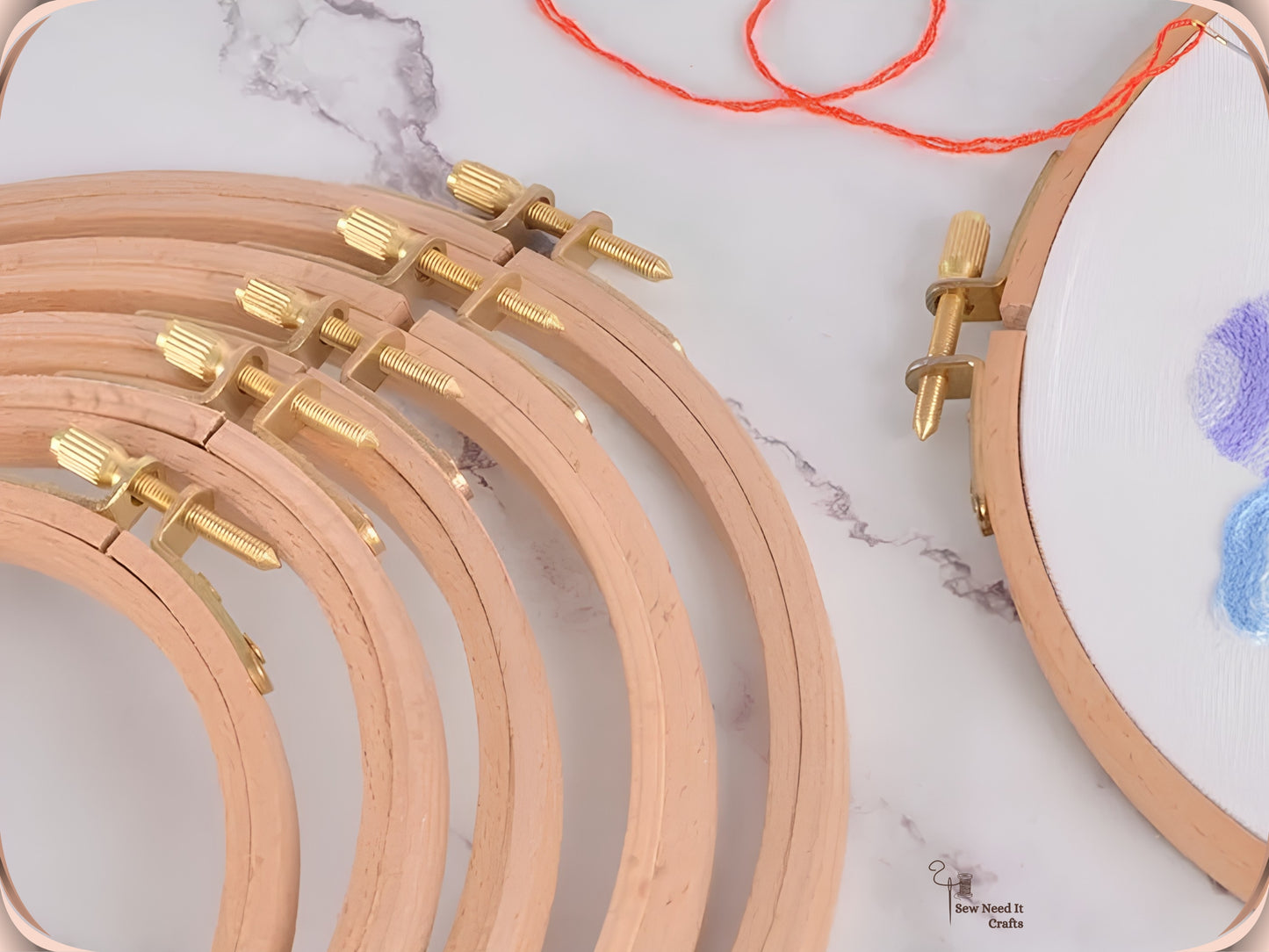
- Hardware: copper-plated screw fitting with a gold finish — a knurled thumb screw you turn by hand, no tool needed. Screw length 41 mm on every size
- Type: classic two-ring screw-tension hoop. The inner ring is a plain solid ring; the outer ring carries the screw
- Band width: 8 mm on every size
- Joint: the bent beech band closes with a 35 mm mitred scarf joint, cut on both the inner and outer faces, giving roughly 280 mm² of glued contact area
- Edges: the two rings meet on edges ground square rather than rounded, so they seat flush against each other
- Sizes: 3, 4, 5, 6, 7, 8, 9, 11 and 12 inch
- Sold as: any single size, or one of three sets — 3 pieces (9 + 11 + 12 inch), 6 pieces (3 to 8 inch), or all 9 pieces (3 to 12 inch)
- Shape: round
Size Guide
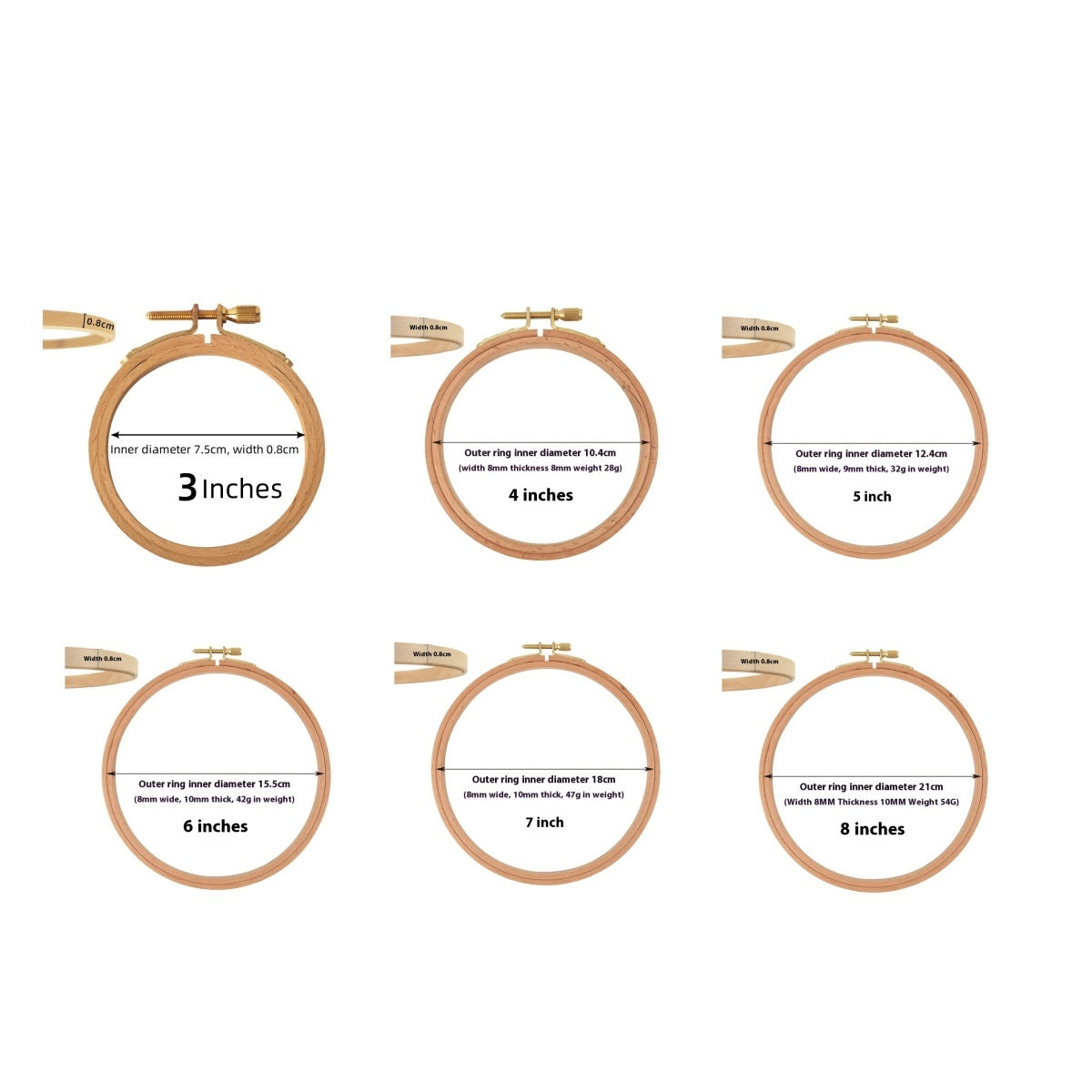
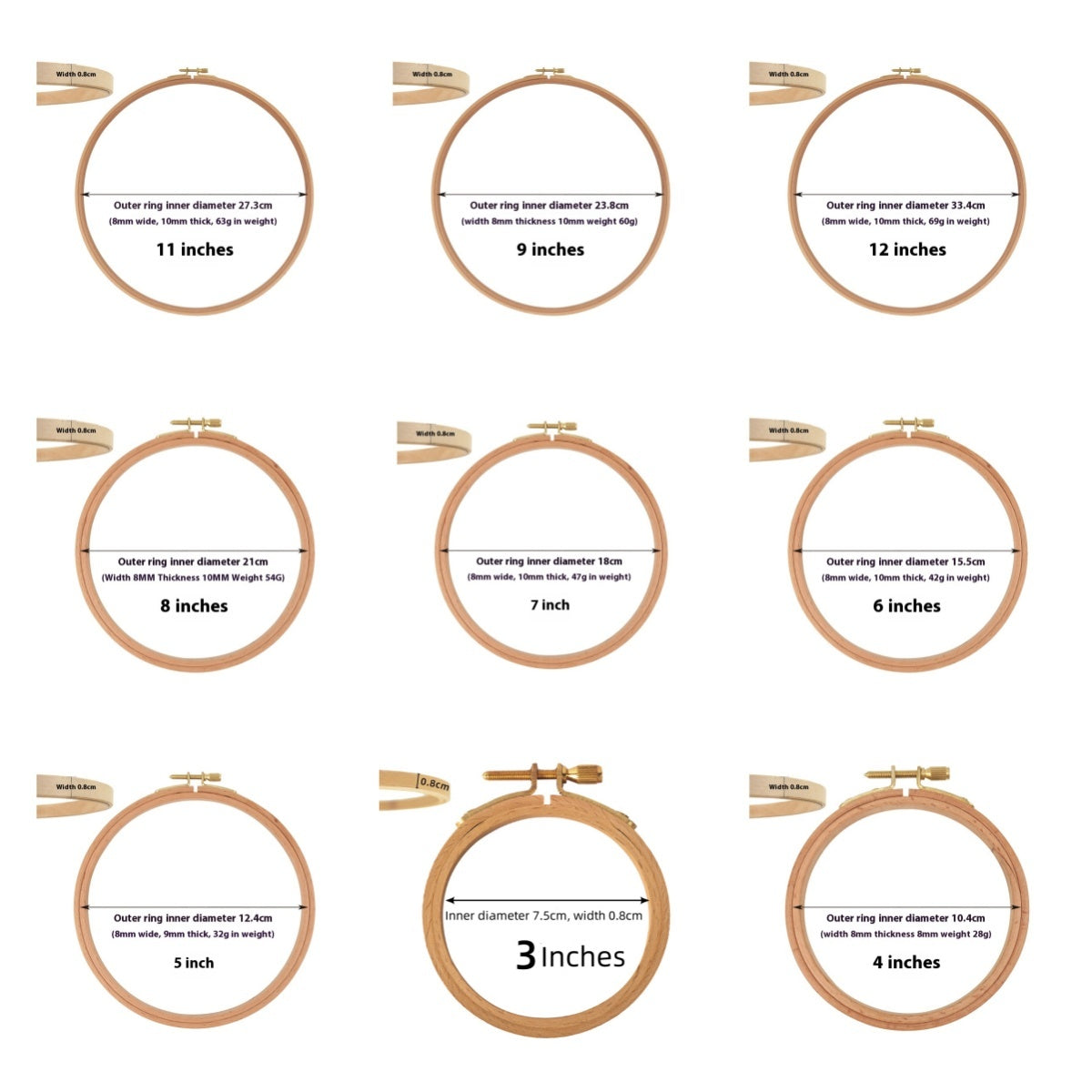
Hoop sizes are named by their nominal inch size, but what actually matters is the working diameter — the inside of the outer ring, which is the circle of fabric you can stitch. Measured figures for every size:
| Nominal size | Working diameter | Band width |
| 3 inch | 7.5 cm (2.9 in) | 8 mm |
| 4 inch | 10.4 cm (4.1 in) | 8 mm |
| 5 inch | 12.4 cm (4.9 in) | 8 mm |
| 6 inch | 15.5 cm (6.1 in) | 8 mm |
| 7 inch | 18 cm (7.1 in) | 8 mm |
| 8 inch | 21 cm (8.3 in) | 8 mm |
| 9 inch | 23.8 cm (9.4 in) | 8 mm |
| 11 inch | 27.3 cm (10.7 in) | 8 mm |
| 12 inch | 33.4 cm (13.1 in) | 8 mm |
The 12 inch runs generously — 33.4 cm of working space, a little over its nominal size, which is worth knowing if you are choosing between the 11 and the 12 for a large piece.

Choosing Your Size
Pick the hoop that comfortably frames the area you are stitching right now, with a few centimetres of spare fabric all round to grip. Bigger is not better — an oversized hoop is heavier in the hand and harder to keep drum-tight.
- 3 to 4 inch — small motifs, patches, ornaments, jewellery pieces, doll clothes
- 5 to 7 inch — the everyday working sizes for surface embroidery and small cross stitch, and the most comfortable to hold for a long session
- 8 to 9 inch — larger designs, punch needle, hoop art you intend to display
- 11 to 12 inch — full samplers and large pieces, or moving a big design around section by section
How to Hoop Your Fabric
- Loosen the thumb screw and lift the outer ring off.
- Lay the inner ring flat on the table and centre your fabric over it, design side up.
- Press the outer ring down over the fabric and the inner ring, working evenly around the circle.
- Tug gently at the edges of the fabric to pull out slack, a little at a time all the way round.
- Tighten the thumb screw with your fingers until the fabric taps like a drum.
The screw is what makes this work. Because you set the tension yourself, you can retighten mid-project when the fabric relaxes, and you can hoop thick and thin fabrics with the same hoop — something a fixed spring or snap hoop cannot do.

Who These Are For
They suit hand embroidery of every kind. Surface embroidery and stumpwork, where you need the fabric taut and the ring smooth enough not to fray your floss. Cross stitch on aida or evenweave, where an 8 mm band is deep enough to grip without crushing the count. Punch needle, which puts real strain on a hoop and is exactly where cheap laminated rings give up. Fine-count needlepoint on smaller pieces. And finishing — a beech hoop makes a good frame for a completed piece, which is why so many hoop-art pieces are displayed in the hoop they were worked in.
Beginners get on well with them because there is nothing to learn beyond turning a screw, and because a set means you are not stuck when the next project is a different size.

How These Are Made
Three details decide whether a wooden hoop holds fabric or lets it creep, and all three happen before the hoop ever reaches a shop.
The joint. A wooden hoop is one long strip of beech, steamed, bent into a circle and glued where the two ends meet. That glue line is where cheap hoops fail — the ring springs apart under tension and the hoop is finished. These are joined with a mitred scarf cut on both the inner and outer faces of the band, 35 mm long, which puts roughly 280 mm² of surface into the glue line instead of the thin butt joint you get on a laminated strip hoop.
The mating edges. The edges where the inner and outer rings press together are ground square, straight down, rather than rounded off. Two flat faces meeting flat is what actually pins the cloth in place — a rounded edge lets fabric roll out from between the rings as you work, which is the real cause of the slow slackening people blame on the screw.
The surface. The ring faces are machine-polished, so the beech is smooth all the way round rather than smooth in the places a hand sander happened to reach. That is what keeps floss from catching on the inner edge, and it is the difference you feel first if you are coming from a splintered bamboo hoop.

How These Compare
Against bamboo craft-store hoops. Bamboo is laminated from strips, and the inner edge tends to splinter with use — which is how thread starts snagging. Beech is a single dense hardwood that polishes to a closed surface, so the ring stays smooth. The joint is the other half of it: a laminated hoop is glued on a thin butt joint that opens under tension, where these carry a 35 mm mitred scarf. Bamboo hoops are also thinner in section and flex more, which is what lets fabric creep loose while you stitch.
Against plastic and flexi hoops. Different jobs. A flexi or faux-wood hoop is quick to pop on and excellent for display and for very delicate fabric you would rather not mark. A screw hoop is what you want while you are actually working, because you set and reset the tension yourself rather than relying on a fixed amount of grip.
Against magnetic hoops. These are not magnetic. Magnets are convenient, but they hold by pressure over a small contact area, they need care around pacemakers and computerised machines, and their grip is set by the magnet rather than by you. A thumb screw pulls the whole ring in evenly and holds as tightly as you decide.
Against a same-size bulk pack. Most multi-hoop deals are a dozen hoops in one size, usually bamboo, meant for craft groups and party favours. The sets here are nine different working sizes in the same hardwood and the same hardware as the singles — a collection you stitch with for years, not a one-off pack.
Materials & Care
Natural beech, machine-polished, unstained and unsealed, so the colour and grain vary a little from hoop to hoop. Wipe with a dry or barely damp cloth; do not soak them, and do not put them in a dishwasher — wood that gets wet can swell and lose its round.
Store hoops loosened rather than clamped tight, and take your work out of the hoop between sessions on delicate fabric so it does not hold a ring mark. If you stitch on silk or fine linen a lot, binding the inner ring with cotton twill tape is a five-minute job that improves the grip and softens the pressure on the fabric.
Frequently Asked Questions
Are wooden embroidery hoops better than plastic?
For holding tension while you stitch, yes. Wood has enough rigidity that the two rings stay circular under pressure and grip evenly all the way round, and a screw lets you tighten further as the fabric relaxes. Plastic and flexi hoops still earn their place for framing finished pieces and for very light or delicate fabric where you want the least possible marking.
What is the best material for an embroidery hoop?
A close-grained hardwood — beech is the traditional choice, and it is what most premium hoops are made from. It sands to a genuinely smooth inner edge, it does not flex under tension the way a thin laminated ring does, and it wears in rather than out. The other half of the answer is the hardware: a solid metal screw you can grip and turn firmly is the part that fails first on cheap hoops.
What is the best quality embroidery hoop?
The one that holds tension without help. Look for four things: a hardwood ring rather than bamboo or plastic, an inner edge smooth enough that you can run a finger round it without catching, edges that meet square so the cloth cannot roll out from between the rings, and a metal screw with a knurled head you can turn hard without it stripping. These have all four, and the glue joint that holds the ring closed is a 35 mm mitred scarf rather than a thin butt joint.
What is the wooden frame for embroidery called?
An embroidery hoop — two rings, an inner one that the fabric sits over and an outer one that clamps down on it. You will also see them called embroidery hoop frames, especially when they are used to display finished work, and cross stitch hoops when they are used for counted work. They are all the same tool.
How big is a 4 inch embroidery hoop?
The 4 inch has a 10.4 cm working diameter, which is the circle of fabric you can actually stitch inside the ring. Every hoop in this range is measured the same way in the size guide above, from 7.5 cm on the 3 inch to 33.4 cm on the 12 inch.
How do I know what size embroidery hoop to use?
Measure your design at its widest point and add roughly two inches. That gives you room to grip the fabric and keeps your stitching away from the ring, where the hoop would otherwise flatten it. If your design is bigger than any hoop you own, hoop one section at a time and move the hoop as you go — that is normal practice, and it is the reason a range of sizes is more useful than one big one.
What is the difference between an embroidery hoop and a quilting hoop?
Depth. Quilting hoops are built deep and heavy, usually 19 to 25 mm, because they have to grip three layers at once — top, wadding and backing. These are 8 mm embroidery hoops, sized for a single layer of fabric with or without stabiliser, which is what keeps them light enough to hold comfortably for a few hours at a stretch.
What is the largest size of an embroidery hoop?
The largest here is the 12 inch, with 33.4 cm of working space — enough for a full sampler or a large hoop-art piece. Beyond that, most stitchers move to a scroll frame or stretcher bars rather than a larger hoop, because a very big hoop gets awkward to hold and harder to keep evenly tight.
Pick the size your next project needs, or take the set and stop guessing.